Metal Roof Vs Asphalt Shingles: SoCal Cost, ROI, and Climate Fit Guide
Quick SoCal snapshot
Metal vs shingles at a glance (what most SoCal homeowners care about)
If you want the fastest “big picture,” start with lifespan and risk. In Southern California, architectural asphalt shingles commonly land in the 15–30-year range, while well-specified metal systems often run 40–70 years. Fire and wind matter too. Many asphalt products can achieve a Class A fire rating as part of a listed roof assembly, while metal panels are non-combustible, which helps when airborne embers are the concern. For impact, inland microbursts and occasional hail are where Class 4 impact-rated shingles can be worth pricing, while metal can dent (cosmetic) yet still stay watertight when the system is detailed correctly.
Maintenance is different. Standing seam is usually lower-touch. Exposed-fastener metal needs periodic fastener/screw checks over time. Shingles need routine inspections for granule loss, lifted tabs, and flashing wear.
What changes the answer in SoCal (coastal vs inland)
Near the coast, salt air pushes you toward corrosion-smart choices (material, coatings, and avoiding dissimilar-metal contact). Inland heat shifts the conversation toward ventilation, attic insulation, and cool-roof performance.
| Topic | Metal roofing | Asphalt shingles | SoCal take |
|---|---|---|---|
| Cost drivers | Higher material + specialized labor | Lower upfront, faster install | Roof complexity and tear-off drive both |
| Lifespan | ~40–70 yrs (system-dependent) | ~15–30 yrs (tier + heat exposure) | Coastal vs inland changes aging rate |
| Heat performance | High reflectance options, cool-roof finishes | Cool-roof shingle options exist | Ventilation + insulation still decide comfort |
| Wind (uplift) | Strong when edges/fastening are right | Strong when nailed correctly + sealed | Santa Ana winds punish weak edges and ridges |
| Wildfire | Non-combustible surface | Class A assemblies available | Ember resistance is about the whole assembly |
| Coastal corrosion | Depends on metal/coating/details | No rust, but faster wear in harsh sun/salt | Material selection and flashing details matter |
| Noise | Quiet with solid sheathing + insulation | Quiet | Assembly matters more than material |
| Solar readiness | Great on standing seam with clamps | Works with flashed mounts | Plan roof/solar timing to avoid paying twice |
What SoCal climate does to roofs (coastal, inland heat, wind, wildfire)
Coastal zones (LA/OC/Ventura/San Diego coast): salt air + fastener/corrosion reality
On the coast, saltair is the slow grind that separates “looks good on day one” from “still tight in year fifteen.” Coastal corrosion doesn’t just show up as rust on a panel. It often starts at the details: cut edges, scratched coatings, exposed fasteners/screws, and places where dissimilar metals touch. That’s why material choice, coating quality, and clean flashing transitions matter so much near the ocean.
Inland valleys/deserts (IE + inland SD): heat load, attic temps, shingle aging
Move inland, and the roof takes more of a beating from heat. Repeated hot days speed up UVdegradation, and asphalt shingles tend to show it first through faster granule loss and brittleness. The wildcard here is the attic. Poor ventilation and weak attic insulation can push attic temperatures high enough to shorten shingle life and make rooms below harder to cool, regardless of what’s on top.
Wind corridors (Santa Ana): uplift, edge details, fastening patterns
Santa Ana events don’t usually “test the middle” of a roof. They test the edges. Wind uplift loads hit eaves, rakes, ridges, and hips hard, especially where the roof geometry creates pressure changes. Starter details, edge metal, and fastening patterns are where good installs separate themselves from bargain bids.
Wildfire-prone areas: ember resistance + roof fire ratings
In wildfire zones, the main threat is often airborne embers finding a weak spot. Class A fire rating helps, but the roof assembly’s gaps and vents matter just as much. A non-combustible surface doesn’t fix sloppy transitions at vents, skylights, or open eave areas.
Optional callout for property managers (multifamily/HOA constraints)
For HOAs and multifamily, appearance rules, long-term maintenance planning, and tenant disruption often drive decisions as much as performance. Choosing systems with predictable service intervals and readily available matching materials can save headaches later.
What “metal roof” means in real products (materials + profiles)
“Metal roof” gets used like it’s one product. It isn’t. In real bids, you’re choosing a metal material plus a profile and finish system, and that combo determines how the roof handles salt air, heat cycling, and long-term maintenance. In SoCal, the common lineup includes steel (either Galvanized or Galvalume), aluminum, and premium options like copper, zinc, or even tin in specialty applications. For most homes, steel and aluminum do the heavy lifting on value.
A quick technical note that matters: Galvalume is a coating made from zinc, aluminum, and silicon. It’s popular because it improves corrosion resistance compared to basic galvanized coatings in many environments, especially when paired with a high-quality paint system. On the finish side, Kynar 500 (PVDF) coatings are often specified when color stability and chalk resistance are priorities.
Standing seam (why it’s common on higher-end SoCal installs)
Standing Seam is the “clean line” option you see on modern homes because the fasteners are hidden and the panel seams are designed to shed water well. It’s also friendly for long service life when the details are done correctly.
Clip systems, movement, and thermal expansion (what good detailing looks like)
Metal expands and contracts with temperature swings. That thermal expansion is normal, but it has to be planned for. Standing seam systems commonly use clips and attachment patterns that let panels move without stressing fasteners or tearing at seams and penetrations.
Exposed fastener/corrugated systems (where they fit, where they don’t)
Exposed fasteners and corrugated metal can be penciled out for simple roof shapes, detached structures, or budget-driven projects. They can perform well, but they’re less forgiving if shortcuts show up in layout, flashing, or fastener selection.
Fastener/screw maintenance and back-out risk (especially with heat cycling)
Because screws are exposed, you should expect periodic inspections. Heat cycling and movement can contribute to fastener loosening over time, and the washer seal is a wear item.
Coastal corrosion notes (aluminum vs coated steel; dissimilar metals / galvanic corrosion)
Near the coast, corrosion planning is part of the system, not an add-on. Aluminum is often favored in salt air for its natural corrosion resistance, while coated steel relies more heavily on coating integrity. Either way, avoid dissimilar-metal contact that can trigger galvanic corrosion, and make sure flashings, fasteners, and panel materials are compatible as a package.
Asphalt shingles in SoCal (tiers, mats, and common pitfalls)
Asphalt shingles aren’t “one roof.” They come in tiers, and in Southern California the tier you pick shows up in wind performance, appearance, and how fast the roof looks tired. The basic option is 3-tab shingles. They’re lighter, flatter, and cheaper, but they’re also easier to damage and harder to keep looking good over time. Architectural shingles (laminate) are thicker and more common on SoCal homes because they resist blow-offs better and hide minor roof-plane imperfections. Designer/luxury shingles push the look further, mimicking slate or wood profiles, and they can make sense when curb appeal is the priority and the neighborhood expectations are high.
Under the asphalt, the “mat” matters. Most modern shingles use a fiberglass mat, which tends to be more stable and fire-resistant than older organic mat products. Heat and sun are the big SoCal stressors. Long runs of hot days accelerate UV degradation, and the first visible signs are often granule loss, then curling at edges, and eventually cracking as the shingle dries out and becomes brittle. In coastal pockets, you may also see algae growth/black streaks, especially where morning moisture lingers.
Architectural vs 3-tab (why 3-tab is less common now)
3-tab can work on tight budgets, but architectural shingles usually deliver better durability per dollar in wind and heat.
Designer shingles (when they make sense)
They’re for homeowners who want a specific look and plan to maintain the roof like a finished element, not just a utility layer.
Ventilation and attic insulation (how shingle life gets cut short)
Bad ventilation and weak attic insulation trap heat, pushing attic temps up and aging shingles faster, even if the product itself is solid.
Moisture + permeability (vapor handling, underlayment, and ventilation)
Moisture problems often start inside the house. Good ventilation and the right underlayment strategy manage vapor and condensation risk so the roof system stays stable over time.
Get a professional roof inspection and clear options from a local SoCal contractor.
No pressure, no generic bids — just a clear explanation of what works for your roof.
Explore our roofing services
https://www.torranceroofingmasters.com/roofing-services/
Title 24, cool-roof choices, and CRRC ratings (SoCal compliance lens)
Title 24 (statewide-ish concepts vs “varies locally” permitting)
California’s Title 24 energy standards are the statewide baseline for energy efficiency, and roof work can trigger requirements depending on your building type, roof slope, and the scope of the permit. The “statewide-ish” part is the framework: when a re-roof needs a permit, the building department may check whether the replacement meets current energy rules. What varies locally is how your city or county applies the permit triggers in practice, what documentation they ask for, and how strict they are on product paperwork. For homeowners, the safest approach is simple: if you’re pulling a permit, expect to be asked about cool-roof compliance and have product data ready.
CRRC numbers: what they are and what they’re NOT
CRRC roofing products are rated for two key properties: solar reflectance (how much sunlight the surface reflects) and thermal emissivity (how efficiently it releases absorbed heat). Those numbers help compare products on an apples-to-apples basis. They don’t promise a specific indoor temperature drop, because attic temps depend heavily on ventilation, insulation, duct leaks, and shade.
Cool roof shingles vs cool roof metal (who benefits most inland vs coastal)
Inland zones with long hot afternoons usually see the biggest comfort and cooling-load upside from cool roof shingles or cool roof metal, especially when paired with balanced ventilation and solid attic insulation. Coastal areas often have milder peak heat, so the benefit can feel smaller day-to-day, but cool-roof options can still reduce roof surface temps and heat soak.
Installation details that decide lifespan (underlayment, flashing, ventilation)
You can buy a premium roof and still end up with premature problems if the “boring parts” were treated like extras. When we see early leaks in SoCal, they’re usually tied to layer choices and transitions, not the brand name printed on the bundle or panel.
Underlayment selection by roof type and climate zone
Underlayment is the backup water-shedding layer under the finished roof. On metal, it also supports how the system handles movement, noise control, and condensation risk. Standing seam installations often rely on clip systems and a fastening layout that allows for thermal movement, so the underlayment and attachment plan must work together. On shingles, underlayment choices still matter, but the big wins come from correct starter strips, clean laps, and a system that matches the roof’s slope and exposure.
In SoCal, moisture is a split story: the coast deals with marine layer dampness, while inland zones deal more with heat cycling. Either way, a cheap underlayment is rarely a bargain.
Flashing scope (chimneys, skylights, valleys, penetrations)
Most leaks come from details. Flashing at chimneys, skylights, valleys, plumbing vents, and other penetrations has to be built as a continuous water path, not a patchwork of sealant. Metal roofs need especially careful transition detailing at penetrations so movement doesn’t stress the joint over time. Shingle roofs need consistent valley methods and correct overlaps so water never finds the edge of a flashing.
Ventilation + attic insulation (heat management and shingle longevity)
Ridge Vents and intake ventilation work as a system. Without balanced airflow, heat builds up, attic temperatures climb, and shingles age faster. Pair that with weak Attic Insulation and you pay twice: comfort drops and cooling costs rise.
Roof decking condition (what gets replaced, what gets reinforced)
A roof is only as solid as the base. Roof Decking that’s soft, delaminated, or water-stained needs repair before new materials go on. This is also where Eave Drip edges are set, where valleys are formed, and where fastening has to bite properly.
Fasteners and edge details (the quiet make-or-break items)
For metal, clip spacing and fastening strategy control movement and long-term tightness. For shingles, correct nailing zones, starter strips, and edge sealing prevent wind-related failures. And in both systems, Fasteners/Screws belong where the manufacturer expects them, not where it feels “close enough.”
The “metal roof noise” myth (what actually controls sound)
When metal gets loud (and why)
Most of the “metal roofs are loud” stories come from the wrong comparison. A bare panel on open framing, a patio cover, or an old barn-style install will drum in the rain. Some lower-cost exposed-fastener systems can also transmit more vibration if the assembly is thin, the attachment pattern is sloppy, or the panel isn’t supported consistently. Add gaps, loose screws, or aging washers and you can get rattles that make people swear off metal forever.
How good assemblies stay quiet
A properly built residential metal roof doesn’t sound like a tin shed. The sound control comes from the layers: solid roof decking, the right underlayment, and enough attic insulation to absorb vibration. Attachment method matters too. Standing seam systems with clip-based fastening tend to handle movement cleanly, which reduces the “pop” and chatter you sometimes hear when metal is constrained. If noise is a top concern, the answer usually isn’t “avoid metal.” It’s “build the assembly correctly,” and make sure the installer is pricing the right layers, not just the panels.
Solar on metal vs shingles (attachments, warranties, best practices)
Solar is where roof choice stops being theoretical. You’re adding penetrations, loads, and long-term service needs, so the roof and the racking plan have to match.
Standing seam + clamps (why it can be “cleaner” when done right)
On standingseam metal, many solar systems can attach using seam clamps that grip the ribs instead of drilling through the panel. Done correctly, that’s a cleaner path because it reduces roof penetrations and keeps water-shedding surfaces intact. It also makes future service easier since panels aren’t covered in a grid of lag bolts. The catch: clamp type, placement, and torque specs matter. A sloppy clamp install can damage seams or create movement issues over time, so you want a solar crew that works with standing seam regularly.
Shingles + flashed mounts (what to insist on)
Shingles can carry solar just fine, but penetrations have to be treated like plumbing vents and skylights: flashed, layered, and positioned with water flow in mind. Insist on properly flashed mounts, correct shingle integration, and a clean layout that avoids valleys and critical drainage zones. Most leak problems we see after solar come from rushed sealing, skipped flashing steps, or mounts placed where water concentrates.
Re-roof timing planning (avoid paying twice)
The simplest money-saving rule is timing. If your shingle roof is already late-life, adding solar can lock you into removing and reinstalling the array sooner than you planned. If you’re deciding between systems and you expect to keep solar for decades, it’s smart to align the roof’s remaining life with the solar system’s life, then document who covers what if a leak or warranty claim ever comes up.
Cost of metal roof vs asphalt shingles in SoCal (what drives bids)
SoCal roofing prices swing because every roof is a different jobsite, not because contractors are guessing. The same 2,000 sq. ft. home can price out very differently based on access, tear-off conditions, roof shape, and how much detail work is required. Metal typically carries higher material cost and more specialized labor, especially for standing seam. Shingles usually install faster, but the scope can grow quickly when you add ventilation upgrades, decking repairs, or complex flashing.
What you want as a homeowner is a clean, comparable scope. If one bid includes new flashing at chimneys and skylights and another “reuses what’s there,” that’s not a real comparison. Same goes for underlayment quality, drip edge, and disposal.
What changes price fast (the 12–18 factor list)
- Roof size and number of facets (simple gable vs lots of hips/valleys)
- Pitch/height (steep work slows production and raises safety costs)
- Stories and access (tight driveways, limited staging, landscaping protection)
- Tear-off layers (one layer vs multiple layers)
- Roof decking condition (dry rot, delamination, skipped sheathing)
- Amount of flashing work (chimneys, skylights, valleys, wall transitions)
- Edge metal and perimeter complexity (rakes, eaves, gutters, fascia condition)
- Ventilation changes (ridge vent added, intake corrected, blocked vents fixed)
- Underlayment tier (basic vs higher-performance systems)
- Material tier (architectural vs designer shingles; metal profile choice)
- Metal specifics (gauge/thickness, finish level, standing seam vs exposed fastener)
- Disposal fees and local hauling distance
- Permit requirements and inspection timing
- Solar removal/reinstall (if applicable)
- Time of year and crew availability (seasonality)
Apples-to-apples bid checklist (compare metal vs shingles fairly)
- Exact tear-off scope (how many layers, what gets replaced)
- Roof decking plan (included repairs or “time and materials”)
- Underlayment type and coverage areas
- New drip edge / eave and rake details included
- Flashing scope spelled out (valleys, skylights, chimneys, vents, walls)
- Ventilation scope (ridge vents + intake strategy, not just “add ridge vent”)
- Fastener/attachment specs (especially for metal systems)
- Cleanup, disposal, and property protection included
- Warranty clarity (workmanship + manufacturer coverage, and what voids it)
Estimator inputs (what we’d ask to price accurately)
- Roof area (squares) and roof shape complexity
- Stories, pitch, and access constraints
- Existing layers and known leak areas
- Any skylights, chimneys, dormers, or heavy penetration count
- Desired material tier (shingle type or metal profile/finish)
- Ventilation/insulation concerns (hot rooms, high attic temps)
- Solar present or planned
- Coastal vs inland exposure and HOA appearance rules
Coastal vs inland cost notes (corrosion-resistant choices; cool-roof shingle options)
Coastal homes may justify corrosion-smart selections for metal (material compatibility, higher-grade finishes, and detail work that prevents dissimilar-metal contact). Inland homes more often benefit from cool-roof choices, where reflective cool roof shingles or reflective cool roof metal can support comfort when paired with proper ventilation and attic insulation.
ROI and total cost of ownership (credible, no-hype framework)
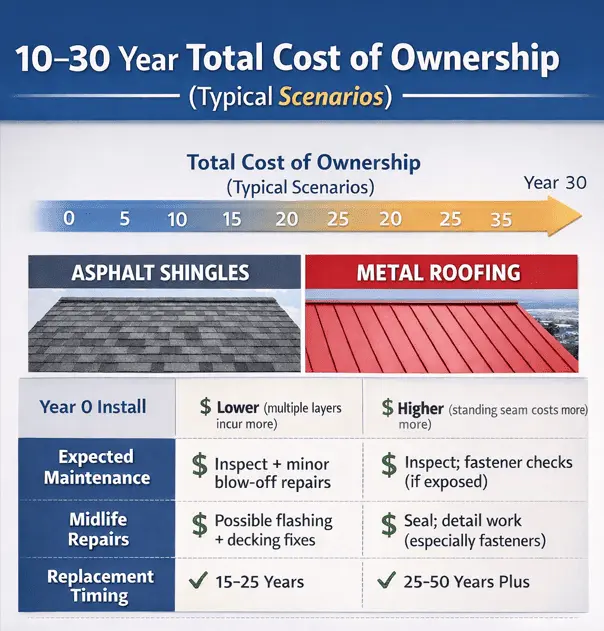
ROI talk gets messy fast because roofs aren’t stocks. The cleaner way to decide is total cost of ownership: what you pay upfront, what you’ll likely spend to keep the roof tight, and when you’ll be buying another replacement.
A practical TCO framework homeowners can use
Start with “year 0” installed cost, then add three buckets: routine maintenance, midlife repairs, and the replacement cycle. Shingles often have a lower entry cost, but you may face more frequent spot repairs in wind-exposed areas, plus earlier replacement if heat and UV accelerate aging. Metal usually asks for more upfront, then tends to shift the spending toward inspections and detail maintenance (especially on exposed-fastener systems). Standing seam can be lower-touch over time when the original detailing is strong.
Energy impact is real, but it’s uneven across SoCal. Inland homes that run AC hard during heat waves are more likely to feel the benefit of reflective surfaces, better attic temperatures, and improved ventilation. Coastal homes often see smaller day-to-day savings because the temperature swing is milder, though comfort can still improve if the attic was poorly vented before.
Resale and appraisal (what’s data-backed vs contractor observations)
Resale value is hard to promise because buyers value roofs differently. What we can say with confidence is that a newer, well-documented roof (permits, warranty paperwork, photos of flashing) tends to reduce buyer objections. Contractor observation: metal can be a selling point on modern homes and in wildfire-minded neighborhoods, but style and HOA rules can limit the upside.
Insurance discounts (Class A, impact resistance, and carrier variability)
Some carriers consider Class A assemblies and impact resistance (including Class 4 shingles) when pricing. Others don’t. Treat insurance discounts as a “possible bonus,” not the reason to choose a roof, and confirm eligibility in writing with your carrier before you count it.
FAQs (SoCal homeowner questions)
Next steps
If you’re stuck between metal and shingles, don’t guess from photos online. A short on-site inspection usually answers the biggest cost and performance questions fast: roof shape complexity, decking condition, ventilation balance, and where wind and water concentrate on your specific home. From there, it’s much easier to choose a system that fits your time horizon and your risk zone.